
The Critical Importance of Pure Lab Water
Laboratory water purification systems are critical for almost any modern lab, as the quality of the water used can directly impact the accuracy and reliability of experimental results. High water purity is essential for preventing contamination and ensuring reliable results in sensitive applications.
The water coming straight from the tap, even if it’s potable, contains numerous impurities that can interfere with sensitive lab work. These contaminants include:
- Ions and salts: Trace amounts of minerals (e.g., Ca2+ [calcium], Mg2+, Na+, Cl−, SO42−) that can precipitate, react with samples, or interfere with electrochemical measurements.
- Particulates: Dust, colloids, and undissolved materials that can clog filters, scratch delicate equipment, and scatter light in optical systems.
- Microorganisms and Pyrogens: Bacteria, viruses, and endotoxins (pyrogens) that are especially problematic for cell culture, molecular biology, and pharmaceutical testing.
- Organic compounds: Natural and synthetic substances (e.g., humic acids, plasticizers, solvents) that can leach from plasticware or be present in the source water, interfering with HPLC, gas chromatography, and other sensitive analytical techniques.
- Dissolved gases: Gases like carbon dioxide (CO2) can affect the pH of the water.
Contamination from chemicals, suspended particles, and organic materials can compromise water purity and lead to experimental errors.
Using water that is not adequately purified for the application can lead to inaccurate data, irreproducible results, high blanks, and even equipment failure. Ultrapure water is often used as a cleaning agent in laboratory and industrial settings to prevent contamination. A dedicated lab water purification system ensures a constant supply of water quality optimized for the specific tasks being performed.
Introduction to Lab Water
When you’re working in a lab, regular tap water just won’t cut it. Lab water or laboratory water as it’s formally called, goes through intensive purification to meet the strict standards that scientific work demands. Think about it this way: while your drinking water or bottled water might contain dissolved minerals and organic compounds that are perfectly fine for consumption, these same impurities can completely mess up your lab results. Even the tiniest traces of mineral salts, volatile organic compounds, or suspended particles can throw off sensitive experiments. That’s why high purity water isn’t just nice to have, it’s absolutely essential for getting reliable results.
Getting lab water to that level of purity involves several proven methods, and each one tackles different types of contamination. You’ve got distillation, which basically uses steam to separate pure water from everything else. There’s reverse osmosis (RO), where water gets pushed through a special membrane that catches dissolved solids, bacteria, and other unwanted stuff. Then there’s ion exchange, which uses specialized resins, both cation resin and anion resin to grab onto charged particles and pull them out of the water. Labs often combine these techniques in sophisticated purification systems, depending on exactly how pure they need their water to be.
Common Types of Lab Water Quality: Deionized Water
Water quality is typically categorized based on the level of purity and is defined by several key metrics, including resistivity, total organic carbon (TOC), and the presence of microorganisms. Different methods such as the demineralization process, distillation, and deionization are used to achieve various levels of water purity, with distilled water considered a much more effective method for removing impurities compared to demineralization alone. While specific grading can vary between organizations (like ASTM, ISO, or CLSI), the three main types of laboratory water are generally classified as follows:
- Type III Water (Primary Grade / Reverse Osmosis Water)
- Primary Purification: Often the first stage of purification, typically produced using Reverse Osmosis (RO), which is a demineralization process that removes minerals and dissolved solids by passing water over a semi-permeable membrane.
- Characteristics: It has removed most of the major contaminants (e.g., >90% of ions and particulates) by removing minerals and trace elements.
- Typical Metrics: High conductivity (low resistivity), moderate TOC.
- Use Cases: General rinsing of glassware, feeding autoclaves, humidifier and water bath supply, and as the feed water for Type I and Type II purification systems. It is not suitable for most critical assays.
- Type II Water (General Grade / Deionized Water)
- Primary Purification: Often involves RO followed by Ion Exchange (Deionization or DI).
- Characteristics: Significant removal of ions and improved microbial control. The quality is a good compromise between purity and cost. (Also known as deionised water or di water.)
- Typical Metrics: Resistivity is typically ≥1.0 MΩ-cm at 25 ∘C.
- Use Cases: Preparation of general reagents and buffers, microbiological media preparation, and as the feed water for clinical analyzers.
- Type I Water (Ultrapure Grade)
- Primary Purification: A comprehensive process that starts with Type II water and runs it through a final stage of purification, often involving Deionization, Activated Carbon (for organics removal), and a 0.22 μm final filter (for particulates and bacteria). Some systems also use UV-light to reduce TOC and remove microorganisms.
- Characteristics: The highest possible quality of water, virtually free of ions, organics, particles, and microorganisms.
- Typical Metrics: The gold standard is a resistivity of 18.2 MΩ-cm at 25 ∘C and a very low TOC (often < 5 ppb).
- Use Cases: Highly sensitive analytical techniques such as HPLC, GC, ICP-MS, molecular biology (PCR, DNA sequencing), mammalian cell culture, and any other application where the slightest impurity could skew the results. Ultra pure water and extremely pure water are required for advanced analytical techniques, including mass spectrometry and sample preparation for trace elements and trace minerals analysis.
When comparing water types, demineralized water is produced by removing minerals and trace elements through the demineralization process, while distilled water is a much more effective method for removing organic materials and suspended particles.
Overview of Purification Technologies Using Ion Exchange Resins
Lab water purification systems utilize a combination of technologies to achieve the different water grades:
- Pre-filtration: Removes large particles and sediment (often done with a simple cartridge filter). This step is essential for purifying water and removing impurities before further treatment.
- Reverse Osmosis (RO): A membrane-based process that uses pressure to force water through a semi-permeable membrane, rejecting a large percentage of dissolved solids and organics. Reverse osmosis is a critical step to remove impurities and prevent contaminants that could form deposits in downstream equipment.
- Deionization (DI) / Ion Exchange: Uses resin beads to remove residual ions, effectively ‘polishing’ the water to very high resistivity. Cation resin beads in this process exchange positively charged ions, such as calcium and sodium, with hydrogen ions to remove ions from the water. The cation exchange resins are periodically regenerated using hydrochloric acid, which restores their ability to continue removing ions.
- Activated Carbon: Adsorbs trace organic compounds, including chlorine and chloramine from the source water.
- Ultraviolet (UV) Oxidation: Uses short-wavelength UV light (often 185 nm and 254 nm) to destroy bacteria and break down organic molecules, thus reducing the TOC.
- Microfiltration / Ultrafiltration: A final, fine filter (often 0.22 μm) or a membrane used to remove particulates, colloids, bacteria, and endotoxins (pyrogens). Regular maintenance is important, as contaminants can form deposits in the system, affecting performance.
The combination of these technologies in a multi-stage system allows a lab to take tap water and produce the specific high-purity water required for their most demanding applications.
Achieve Breakthrough Results with Harmony Scientific (HS) Lab Water Purification Systems
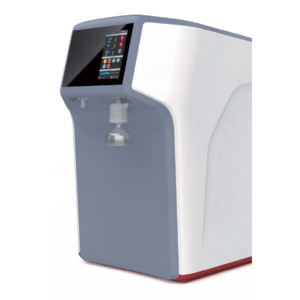
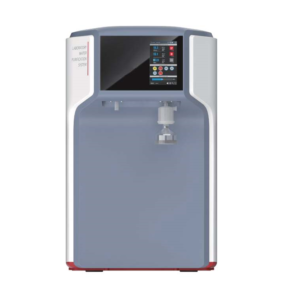
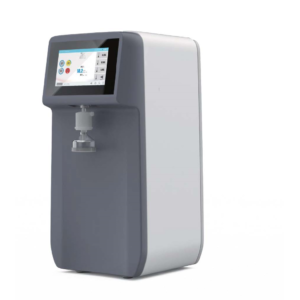
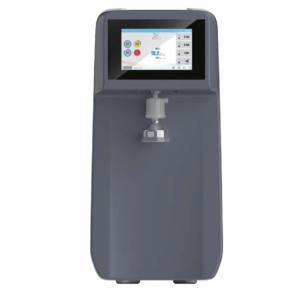
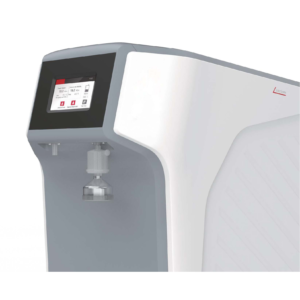
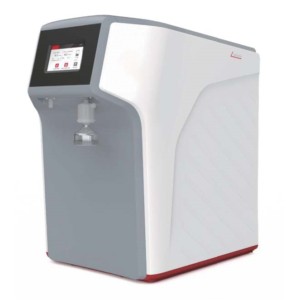
LabAlliance distributes Harmony Scientific Water Purification System. HS is dedicated to advancing scientific research by providing high-quality, intelligent, and automated laboratory instruments. HS commitment to advanced product design and cutting-edge technology ensures your lab water meets the highest standards of purity, enhancing the accuracy and reliability of your critical experiments.
Choose the perfect purification system for your application from our three leading series:
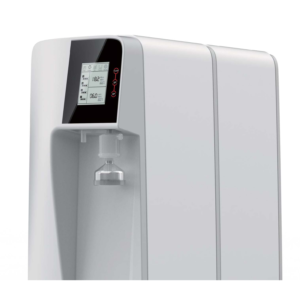
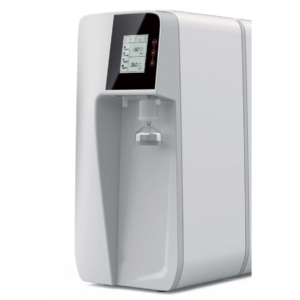
1.The Economical Choice: HS Series (Water Purifier for Lab)
The HS Series is positioned as the smart, cost-effective entry point for labs needing reliable daily access to high-purity water without the high-end features (like the extensive touchscreens or advanced double-purification stages) of the HX or HE lines.
Feature: HS Series (Economical Model)
RO Technology: Single RO System (stable and reliable performance).
Display & Control: Automatic Control System and LCD Display (simpler, essential readouts)
Design: Compact design often with a built-in 1.8 L pressure water tank.
Water Output: Simultaneously produces Ultrapure Water (18.2 MΩ-cm) and Single RO Water (Type III/Pure Water).
Benefit: Lower initial cost and simpler operation for labs on a tight budget.
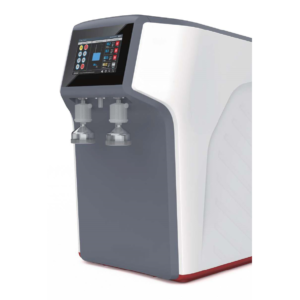
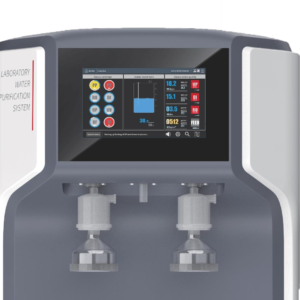
- Ultra Purification Water System (HXU Series)
The HXU Series is your primary solution for producing ultrapure (Type I) water directly from tap water. This series offers essential flexibility to meet a wide range of analytical and life science requirements.
Feature & Benefit
- Modular Design: Easily customize purity level for specific tests.
- UV Lamp Options (UV): Reduces TOC (Total Organic Carbon) for sensitive organic analysis
- Ultrafiltration Options (UF): Removes Pyrogens/Endotoxins, essential for Cell Culture and Molecular Biology.
- Versatile Flow Rates: Choose from Models HXU−20, HXU−40, HXU−60 to suit varying daily volume needs.
- Double RO Ultra Purification Water System (HXUS Series)
For labs requiring consistently higher volumes of high-purity water, the HXUS Series steps up the performance. By incorporating a Double Reverse Osmosis (Double RO) stage, this system ensures superior feed water quality, extending the life of the final purification cartridges and ensuring unparalleled stability in your Type I water output.
Feature & Benefit
- Double RO Stage: Delivers highly stable and low-ionic feed water for maximum cartridge longevity.
- Superior Purity Stability: Minimizes performance drift, perfect for long-term analytical tasks.
- Low TOC and Pyrogen Options: UV and UF options are available for specialized needs like DNA/RNA work and critical spectroscopy.
- Double RO Ultra Purification EDI Water System (HXUE Series)
The HXUE Series represents the pinnacle of lab water technology, integrating Double RO with EDI (Electro-Deionization). This sophisticated combination is designed for the most demanding high-volume research environments. EDI is a continuous, chemical-free process, eliminating the need for periodic chemical regeneration of ion exchange resins.
Feature & Benefit
- EDI Technology :Chemical-free deionization resulting in lower maintenance and stable, high-quality Type II water production.
- Maximum Reliability: Ideal for applications like feeding large automated clinical analyzers and high-throughput production labs.
- Complete Assurance: UV, UF, and UVF configurations ensure ultra-low TOC and certified endotoxin-free water for the most stringent research protocols.
Advance your scientific work with instruments built on expertise and cutting-edge technology: Turn to Harmony Science for Cutting-Edge Purification. Effortless Control. Uncompromized Science.
Can refer to this for photos
https://www.harmony-scientific.com/ProductInfoCategory?categoryId=236987&PageInfoId=0
Showing all 6 results