Centrifuge: Newton Centrifuge for Trusted Results Every Spin

Laboratory centrifuges are indispensable tools for modern scientific research and clinical diagnostics. They function by spinning samples at high speeds to generate Relative Centrifugal Force (RCF), which separates components based on their density. From small-volume separations to large-scale processing, Newton Scientific’s comprehensive range of centrifuges offers a solution for every laboratory need.

The versatility of Lab Alliance centrifuges makes them essential across numerous fields:

Medical and Clinical Labs: They are routinely used to separate blood components. For instance, a centrifuge can separate blood into its plasma, buffy coat (containing white blood cells and platelets), and red blood cells. This is crucial for diagnostics, blood transfusions, and isolating DNA or RNA from a patient’s sample.

Molecular Biology and Biochemistry: Centrifuges are fundamental for DNA and protein isolation. They are used to pellet cells from a culture, separate cellular components (like mitochondria or nuclei), and purify proteins from a solution. High-speed centrifuges, or ultracentrifuges, are powerful enough to separate even the smallest molecules like ribosomes and viruses.

Pharmaceuticals: They are used in the formulation of drugs to separate a solid drug from its solvent. In vaccine development, centrifuges help to isolate viruses or viral components.

Environmental Science: Centrifuges help in water quality testing by concentrating microorganisms or contaminants from a water sample, making them easier to analyze.

Food and Dairy Industry: Centrifuges are used to separate fat from milk in the production of skim milk and cream. They are also used to clarify fruit juices and wine by removing solid particles.

In essence, a centrifuge is not just a single-purpose tool but a versatile instrument that allows scientists to manipulate and analyze matter at a microscopic level, making it indispensable for both research and industrial processes.

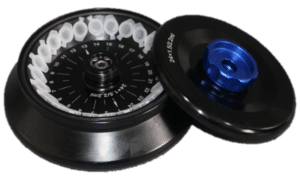
There are two main types of rotors used in a centrifuge, namely a fixed angle rotor and a swing out rotor. Fixed angle rotors are designed to hold tubes at a fixed angle, usually at an angle of 45°, where the sample will move and sediment at a fixed angle at the side of the tube. In a fixed angle rotor, denser material will collect at the bottom of the tube at a fixed angle, making this type highly suitable for applications that require higher speeds and efficient pelleting, such as cell, DNA, or protein separation. Fixed angle rotors can withstand higher speeds and produce faster separations, providing more efficiency for the sample and material being processed.

On the other hand, a swing out rotor uses buckets that can swing out horizontally when the rotor is spinning. With this design, the sample will sediment evenly at the bottom of the tube, making swing out rotors more suitable for applications such as density gradient separation or live cell isolation, where more precise and careful separation is required. The main difference between these two types lies in the angle and location of material sedimentation, as well as the ability to achieve higher speeds with fixed angle rotors. 

The choice between a fixed angle rotor and a swing out rotor will depend on which application is needed, whether efficiency or precision is the priority, and on the type of material being processed. Understanding the advantages and disadvantages of each rotor type is the key to ensuring optimal separation results with the centrifuge in use.

Newton Scientific offers a complete line of centrifuges, from compact microcentrifuges for small-scale work to large floor-standing models for high-volume processing.

Introduction to Newton Centrifuge

Newton Centrifuge is a laboratory instrument designed to facilitate the separation of materials based on density and particle size. In every centrifugation process, the selection of rotor type is very important to ensure optimal results. The two main types of centrifuge rotors used in Newton Centrifuge are the fixed angle rotor and the swing out rotor.

A fixed angle rotor holds tubes at a fixed angle, usually around 45 degrees, throughout the spinning process. With this design, denser material or pellets will accumulate at the bottom of the tube at a fixed angle, allowing separation to occur faster and more efficiently. Fixed angle rotors are the preferred choice for applications such as pelleting bacteria, yeast, and mammalian cells, where the need to collect pellets at a specific location is crucial. Fixed angle rotors are also made from high-quality materials such as aircraft-grade alloys, allowing them to operate at high speeds without compromising safety or sample integrity.

Meanwhile, a swing out rotor allows the bucket holding the tubes to swing out horizontally when the centrifuge spins. This enables separated material to sediment evenly at the bottom of the tube, making swing out rotors highly suitable for applications that require distinct layer separation, such as plasma and serum separation from blood. To ensure compatibility and safety, selecting buckets and adaptors that match the tube size is important, and sealed lids can be used to prevent spillage during high-speed processes.

By understanding the differences between fixed angle rotors and swing out rotors, Newton Centrifuge users can choose the rotor type most suitable for their application needs. The right rotor selection not only enhances separation efficiency but also helps reduce the risk of errors and ensures consistent results with every spin. Newton Centrifuge offers flexibility and reliability in every laboratory application, making it the top choice for a wide range of material separations.

Microcentrifuges: The Lab Workhorse

Microcentrifuges are compact, high-speed centrifuges designed for small-volume samples, typically in 0.2 to 2.0 mL tubes. They are a staple in molecular biology, biochemistry, and clinical labs.

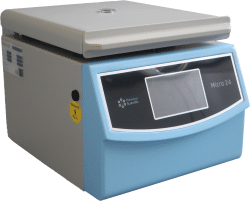
Models and Purpose: The Micro 24 and Micro 24R models from Newton Scientific are ideal for everyday laboratory use. They offer high speeds (up to 16,500 rpm or 20,625 x g) for applications like:

  •       Pelleting cells and precipitates from suspensions.
  •       DNA/RNA extraction and plasmid DNA isolation.
  •       Microfiltration and quick spins for PCR tubes.

Key Feature: The Micro 24R is a refrigerated model, which is crucial for handling temperature-sensitive samples like DNA, RNA, and proteins, ensuring their integrity during high-speed separation.

Microcentrifuges are typically used for processing the sample with the rotor that holds tubes at a fixed angle, usually an angle of 45°. In a fixed-angle rotor, the sample is spun at higher speeds, allowing efficient pelleting of material at the bottom of the tube. This design is used for rapid separation of biological material, ensuring that the pellet forms at the bottom of the tube, which is essential for many laboratory protocols.

Benchtop Multi-Function Centrifuges: Versatility and Power

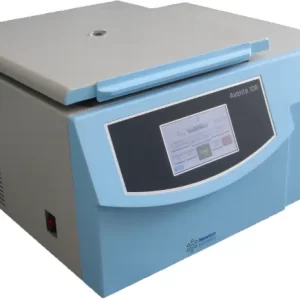
Benchtop centrifuges provide a balance of speed, capacity, and flexibility, making them suitable for a wide range of applications. They are larger than microcentrifuges and can accommodate various tube sizes and rotors.

Models and Purpose: Newton Scientific offers models like the Avante 8 & 8R and Avante 10 & 10R, which are multi-purpose instruments for sample volumes up to 100 mL. Their key applications include:

  •       Cell culture pelleting and harvesting.
  •       Serum and plasma preparation from blood samples.
  •       Protein research and tissue culturing.

Key Feature: These models come with a variety of rotor options (fixed-angle and swinging-bucket), allowing for different separation techniques. Swing out types of the rotor are equipped with buckets, which hold the sample and allow material to sediment at the bottom of the tube. This design is used for applications where it is important for the sample to form a pellet at the bottom of the tube, such as separating layers of material with the best efficiency. The refrigerated ‘R’ models are essential for protecting thermally labile samples during longer runs or at high speeds.

Floor Standing Centrifuges: For High-Volume Processing

Floor standing centrifuges are the largest and most powerful centrifuges, designed for processing large sample volumes. They are commonly used in industrial settings, blood banks, and large-scale research facilities.

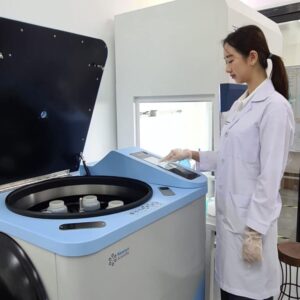
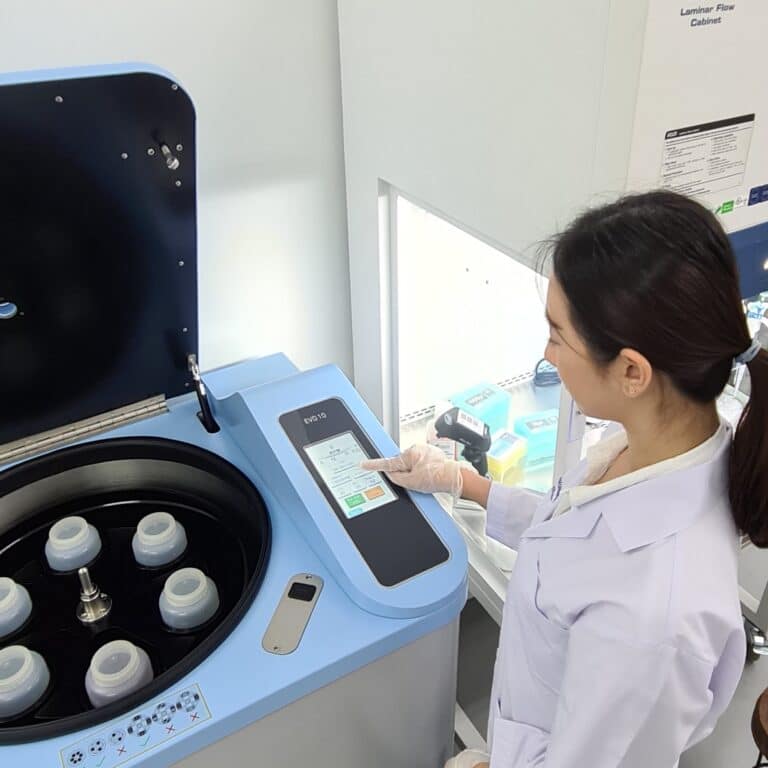
Models and Purpose: The Evo Series of floor centrifuges, such as the EVO 10 and EVO 25, are built for high-throughput sample processing. They can handle capacities up to 12 liters and reach speeds up to 25,000 rpm. Their primary uses include:

  •       Bioprocessing and large-scale cell harvesting.
  •       Blood banking for the separation of blood components.
  •       Large-scale sample preparation for industrial production.

Key Feature: These centrifuges are built for high performance and safety, with features like imbalance protection, overspeed detection, and motorized lid locks. In addition, this model can be equipped with various types of rotors, allowing optimal material separation according to the application. Their large capacity and high RCF are critical for separating bulk samples efficiently.

Showing all 5 results

Newton Scientific EVO Series Floor Centrifuge

Newton Scientific EVO Series Floor Centrifuge

Newton Scientific floor standing high speed centrifuges simplify high-throughput sample processing with up to 64,800 x g, maximized capacity up to 12 liters, and an extensive rotor portfolio. Supporting labware from microtubes, to 1 Liter bottles. Overcome challenges of a shared laboratory setting with the productivity, safety, and reliability of a Newton Scientific Centrifuge.

Newton Scientific Micro 24 & Micro 24R Microcentrifuge

Newton Scientific Micro 24 & Micro 24R Microcentrifuge

Newton Scientific Micro 24 & Micro 24R microcentrifuges is ideal for everyday laboratory use with maximum speed of 16,500 rpm and RCF up to 21,616 x g. It provides outstanding processing power, unique safety features and a broad array of microcentrifuge rotors and accessories for microcentrifuge tube processing. Unit comes complete with a 24 x 1.5/2.0 ml angle rotor.

Newton Scientific Syclone® Mini Centrifuge

Newton Scientific Syclone® Mini Centrifuge

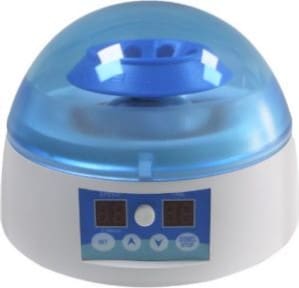
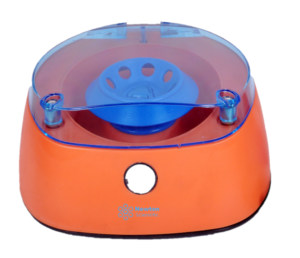
Newton Scientific has just launched our latest line of mini microcentrifuges! The new Syclone® mini microcentrifuges will join our family of SonicSpin™ Mini Centrifuges.

The Syclone® Mini Centrifuge is designed for the centrifugation of microcentrifuge tubes and PCR strips.