
Bulk Density: The Ultimate Guide to Choosing the Right Density Measurement for Your Powder
In the world of material science and manufacturing, “density” is rarely as simple as mass divided by volume. If you are working with powders—whether in pharmaceuticals, battery materials, or metallurgy—the way you measure density can completely change your production outcome. Accurately measuring true density, bulk density, and tapped density is essential for assessing powder quality, optimizing the manufacturing process, and ensuring reliable data in scientific research.
Why Density Matters: Applications Across Industries
Getting density measurements right makes all the difference when you’re trying to deliver quality products that actually work. Think about it this way – in pharmaceuticals, the density of your powders determines whether each pill has the right amount of active ingredient. Too much variation here, and you’re looking at serious safety and effectiveness issues. The food industry faces similar challenges. When powder density is off, you’ll see problems with texture, packaging, and those automated systems that handle filling and mixing. Nobody wants their production line grinding to a halt because powders aren’t flowing properly.
Cosmetics manufacturers know this struggle too. They need consistent density to ensure their powders and creams feel right to consumers – because let’s be honest, texture matters just as much as performance in that world. Here’s something interesting: powders with higher density generally flow better through equipment, which means fewer headaches with blockages and smoother operations overall. When you really understand and control powder density, you’re setting yourself up to meet industry standards while keeping customers happy. It’s one of those foundational elements that impacts everything downstream.
Key Factors Influencing Powder Density Measurements
Getting accurate powder density measurements isn’t as straightforward as it might seem—there are quite a few factors that can throw off your results if you’re not paying attention. Particle size matters more than you’d think. Fine powders behave very differently from coarse ones when it comes to packing, which directly affects both your bulk and tapped density readings. The shape of those particles plays a big role too. If you’re dealing with irregular particles, they tend to trap more air, and that’s going to give you lower density numbers than you’d expect. Then there’s surface area and porosity to consider—these affect how your powder interacts with air and moisture, making things even trickier.
You’ll want to keep a close eye on your testing environment as well. Temperature and humidity can really mess with your measurements if they’re not properly controlled. When you need deeper insights into how your powder flows, shear cell analysis can be incredibly helpful. For true density measurements where accuracy is everything, gas displacement techniques are your best bet. Here’s something practical you can use right away: the Hausner ratio. It’s simply your tapped density divided by your bulk density, and it gives you a solid way to evaluate how well your powder flows. When you understand and manage all these variables, you’ll get much more consistent and meaningful measurements that actually help you control your processes and maintain product quality.
Sample Preparation for Density Measurements
Getting your powder sample ready properly makes all the difference when you’re measuring density accurately. You’ll want to make sure your sample truly represents what you’re working with, which often means sieving, milling, or giving it a thorough mix before you start testing. Drying out any moisture is really important here – even tiny amounts of water can throw off your measurements more than you’d expect.
Handle everything carefully to avoid accidentally compacting the powder or introducing air bubbles, since both will mess with your results. Modern automated systems can be a real game-changer for this work, helping you standardize how you prep samples and take measurements. When you stick to solid preparation methods and work with good equipment, you can feel confident about your density readings, fine-tune your processes, and keep delivering the consistent quality your customers count on.
Understanding Powder Density: True, Bulk, and Tapped
Understanding the nuance between True, Bulk, and Tapped density is critical for quality control, packaging, powder flowability analysis, and flow behavior of bulk solids. True density (sometimes called absolute density) looks at just the actual material itself, ignoring any tiny pockets or gaps between particles. Think of this as the real, intrinsic density of your powder material. Bulk density works differently. It measures what happens when you pour powder into a container and let it settle naturally, air spaces and all. This gives you a practical picture of how the powder behaves in real-world situations. Then there’s tapped density, which takes things a step further by gently tapping the container to help the powder settle more compactly. The relationship between these measurements tells you a lot about how your powder will perform. When bulk density is higher, you’ll often see better flow properties. But if there’s a big gap between bulk and tapped density, that’s usually a red flag for flow issues or powder that tends to clump together. These measurements aren’t just academic—they’re essential tools that help you predict how your powder will handle during processing, shipping, and storage.
Here is your ultimate guide to choosing the right measurement for your application.
- True Density: The Absolute Baseline
What it is: Also known as skeletal density, this is the density of the actual solid material, excluding all pores and the spaces between powder particles. True density is determined by measuring the sample’s mass and dividing it by the true volume, which excludes open and closed pores within the material.
- Why it matters: It helps identify material purity and is essential for calculating the theoretical porosity of a compacted part. Accurately measuring true density is crucial for optimizing the manufacturing process and obtaining reliable scientific data.
- The Gold Standard: To measure this accurately, you need gas pycnometry. The Micromeritics AccuPyc II is the industry leader for this. It uses helium displacement to reach into even the tiniest pores, providing high-speed, high-precision volume measurements that liquid displacement methods simply cannot match. In gas pycnometry, the measured volume is determined by gas displacement in a sealed chamber. Closed pores do not interact with gases during pycnometry measurements, which can affect the accuracy of density calculations and are relevant in distinguishing between open and closed cell structures in materials like plastics and powders.
- Bulk Density: The Real-World Volume
What it is: This is the density of the powder “as poured.” It includes the volume of the particles plus the volume of the air gaps (inter-particle voids) between them. Bulk density is the mass per unit volume of a loose powder bed, including the spaces between the particles and the envelope volumes of the particles themselves.
- Why it matters: Bulk density is vital for designing storage bins, hoppers, and deciding how much material will fit into a capsule or a shipping container. Structural engineers use the bulk density of materials to calculate the dead load of structures, ensuring safe design. Bulk density also helps builders calculate the volume and weight of aggregates needed to mix durable asphalt and concrete, and is crucial for evaluating site stability and preparing foundation designs.
- The Challenge: Because it includes air, bulk density is highly sensitive to how the powder was handled or poured. In agriculture, soils with a high bulk density (typically above 1.6 g/cm3) become too tightly packed for roots to grow or penetrate deeply, while low bulk density indicates high porosity, allowing essential oxygen to reach plant roots and facilitating excess water drainage.
- Tapped Density: Predicting Flow and Settlement
What it is: This is the density reached after a container of powder has been mechanically tapped or vibrated for a specific period. This process causes the particles to rearrange and settle, minimizing the air gaps.
- Why it matters: Tapped density is used to calculate the Hausner Ratio, Carr Index, and compressibility index, which are the primary indicators of a powder’s flowability and packing characteristics, especially important in pharmaceutical manufacturing processes such as capsule filling.
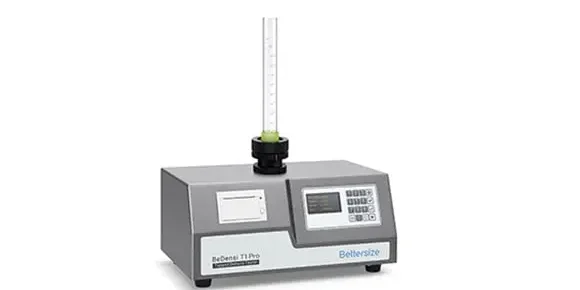
- The Precision Tool: For repeatable results that meet international standards (like USP or ASTM), the Bettersize BeDensi T Pro Series is the ideal solution. It automates the tapping process, ensuring that the force and frequency are consistent every time, removing human error from the settling equation. The tapped density tester ensures fixed drop distances and rates for standardized testing.
| Feature | True Density | Bulk Density | Tapped Density |
| Volume Includes | Solid material only | Solids + Voids + Pores | Solids + Pores (Minimal Voids) |
| Primary Use | Material ID & Purity | Storage & Packaging | Flowability & Compaction |
| Key Instrument | Micromeritics AccuPyc | Graduated Cylinder | Bettersize BeDensi |
Analysis Procedures: How They Differ in the Lab
While all three measurements relate to density, the physical steps taken in the lab are vastly different. Here is a breakdown of the standard analysis procedures:
True Density (Gas Pycnometry)
Measuring true density with the Micromeritics AccuPyc is a non-destructive process that relies on the Ideal Gas Law (PV = nRT).
- Sample Loading: The powder sample is placed in a sealed chamber of a known volume. Using representative samples and consistent sample weight is important for accurate results.
- Gas Displacement: An inert gas (typically Helium) is introduced. Helium is used because it can penetrate pores as small as one-tenth of a nanometer.
- Pressure Equilibrium: The device measures the pressure drop when the gas is expanded into a second reference chamber.
- Result: The instrument automatically calculates the skeletal volume of the powder. The measured volume is determined by gas displacement, and the sample’s mass is combined with this measured volume to calculate true density. Because gas is used rather than liquid, there is no risk of the sample dissolving or the surface tension blocking small pores. True volume excludes closed pores, which do not interact with the gas during measurement.
Bulk Density (Poured Method)
The procedure for bulk density is the most straightforward but requires a steady hand to maintain consistency.
- Sieving: The powder is often passed through a large-mesh sieve to break up any clumps caused by storage.
- Pouring: The sample is carefully poured into a graduated cylinder or a “density cup” of a known volume until it overflows.
- Leveling: The excess powder is leveled off the top without compressing the sample.
- Weight: The sample weight (or sample’s mass) is recorded, and density is calculated as Mass / Volume. Consistent sample weight measurement is important for reliable results.
Tapped Density (Mechanical Settlement)
The procedure for tapped density using the Bettersize BeDensi T Pro series ensures that the “settling” is standardized and reproducible.
- Initial Loading: A known mass of powder is placed in a graduated cylinder, and the initial bulk volume is recorded.
- Standardized Tapping: The cylinder is placed on the tapped density tester. The user sets the number of taps (e.g., 500 or 1250) and the drop height according to USP or ASTM standards.
- Volume Measurement: After the cycles are complete, the user reads the new, lower volume occupied by the settled powder.
- Calculation: The software (or user) calculates the Tapped Density, as well as the Hausner Ratio, Carr Index, and compressibility index, to determine if the powder is free-flowing or cohesive. The compressibility index is significant for evaluating powder flowability and packing characteristics.
| Method | Medium Used | Action | Human Intervention |
| True (AccuPyc) | Helium/Nitrogen Gas | Pressure Displacement | Minimal (Automated) |
| Bulk | Air | Gravity Pouring | High (Manual Leveling) |
| Tapped (Bettersize) | Air | Mechanical Tapping | Low (Set & Forget) |
Which One Do You Need?
Choosing the right measurement depends on your stage of production:
- Formulation & R&D: You likely need True Density to understand the fundamental characteristics of your material and powder particles, which is essential for material characterization.
- **Logistics & Storage:**Bulk Density will tell you how much space your product occupies on a shelf and is critical for processing and handling bulk solids.
- **Manufacturing & Quality Control:**Tapped Density is essential to ensure your powder flows correctly through your machinery without clogging.
Expert Solutions at LabAlliance
At LabAlliance Sdn Bhd, we specialize in providing the scientific community with the highest caliber of analytical instrumentation. Whether you require the unmatched precision of Micromeritics for gas pycnometry or the robust reliability of Bettersize for tapped density analysis, our team is here to support your laboratory’s needs.
Ready to optimize your powder characterization? Connect with us, speak with our technical specialists about the AccuPyc and BeDensi series.