
Why Your Density Measurements Are Inconsistent: Matching the Method to the Material
In the world of material science, density is defined as the mass of a substance divided by its volume, typically represented by the Greek letter rho (ρ). The SI unit for density is kilograms per cubic meter (kg/m³), but other common units include grams per cubic centimeter (g/cm³) and pounds per cubic foot (lb/ft³). Each substance has a unique density due to its molecular composition and atomic arrangement, and density can vary based on material composition and structure—homogeneous materials have uniform density throughout, while heterogeneous materials exhibit different densities in different regions. Density measurement is crucial in various industries for quality control, determining concentration, and ensuring product consistency.
However, if you’ve ever sent the same sample to two different labs and received two different results, you’ve experienced the Volume Paradox.
The truth is, density is not a single measurement—it is a property defined by the mass per unit volume that your material occupies. To get consistent, repeatable, and accurate results, you must match your density measurement method to your sample’s physical state and account for factors like air bubbles, impurities, temperature change, and pressure. Density values can be affected by the presence of air bubbles or impurities, and accurate measurements require eliminating or accounting for these factors.
The “Volume Paradox”: Why Results Vary
The inconsistency usually stems from how an instrument accounts for “void space.” Depending on your sample type—whether it’s a porous catalyst, a fine powder, or a volatile liquid—the “volume” can include or exclude:
- Inter-particle voids (the air between grains).
- Intra-particle pores (the microscopic holes inside the material).
- Atomic spacing (the actual solid skeleton).
If your method doesn’t match your material, you aren’t measuring the true density of a substance; you’re measuring air or apparent density, which can differ from true density. For accurate density calculations and density values, it’s essential to select the appropriate method for the material type and ensure that the measurement is performed under standard conditions (certain temperature and pressure).
Identifying Your Sample Type and Method
- Fine Powders and Porous Solids
- The Challenge: These materials have tiny pores that air or liquids cannot easily penetrate.
- **The Solution:**Gas Pycnometry (True Density)
- How it works: Using a gas like Helium, instruments like the Micromeritics AccuPyc can penetrate even the smallest pores (as small as 0.1 nm). This non-destructive technique measures the “True” or “Skeletal” density—the mass of the actual solid material divided by its known volume, excluding open pores and voids. Gas pycnometry is suitable for samples with small pores and irregular shapes and is commonly used for battery materials, pharmaceuticals, and catalysts.
- Coated Tablets, Pellets, and Large Chunks
- The Challenge: You often need to know the density of the object as a whole, including the pores inside it (e.g., to see how a coating affects a tablet).
- **The Solution:**Dry Displacement (Envelope Density).
- How it works: Instead of gas, a “quasi-fluid” (like small glass spheres) is used to surround the sample without entering the pores. This measures the “Envelope” volume, providing the apparent density of the object. Hydrostatic weighing is another method used to determine the density of solids and liquids by measuring the buoyancy effect on a submerged object, which is especially useful for determining relative density or specific gravity by comparing two values (mass in air and mass in liquid).
- Common Use: Insulation materials, pharmaceutical tablets, and specialized foams.
- Loose Bulk Materials
- The Challenge: How much space will this powder take up in a drum or a capsule?
- **The Solution:**Tapped Density.
- How it works: The sample is mechanically tapped until the volume stops changing. This accounts for how the particles settle during shipping or processing. Bulk density is calculated as the mass of the material divided by its bulk volume, which includes voids and pores. Bulk density is relevant for many materials like sand, powders, and grains, and is important for logistics and storage.
- Common Use: Food processing, manufacturing, and logistics.
- Liquids and Slurries
- The Challenge: Volume changes drastically with temperature and pressure.
- **The Solution:**Digital Oscillating U-Tube.
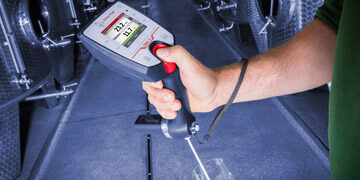
- How it works: Digital density meters (including portable and benchtop models) use the oscillation of a U-shaped tube filled with the liquid to measure density with high accuracy and minimal sample volume. A hydrometer is also a common instrument used to measure the density of liquids by floating in the liquid and providing a reading based on the level of immersion. Density measured in liquids can be affected by viscosity (thickness), temperature, and impurities, so measurements must be performed at a certain temperature and under standard conditions for consistency.
- Common Use: Essential oils, fuels, oleochemicals, and quality control in food and beverage (e.g., Brix measurement), pharmaceuticals (specific gravity of cosmetics), and petrochemicals (density of heavy oils and lubricants).
Consistency Requires Strategy
Inconsistent density data is rarely the fault of the operator; it is usually a mismatch between the material’s physics and the instrument’s logic. Not all density is measured the same way—there are different types of density measurements (true, apparent, bulk, relative)—and using the wrong tool can compromise your entire dataset. Density calculations often involve measuring two values (mass and volume) and calculating their ratio to determine the density value. The ratio of densities between two substances (relative density or specific gravity) is used to compare materials, and differences in density can be illustrated by comparing objects of the same volume but different masses (for example, a copper cube and an aluminum cube of the same size will have different masses due to their different densities).
This flowchart below serves as a practical guide to help you make an informed judgment on which instrument fits your needs. Simply identify your sample’s physical state—liquid, solid, or powder—to find the industry-standard method for achieving repeatable, high-precision, and accurate measurements.