
GERSTEL MOSH/MOAH Analysis in Food: Methods and Challenges
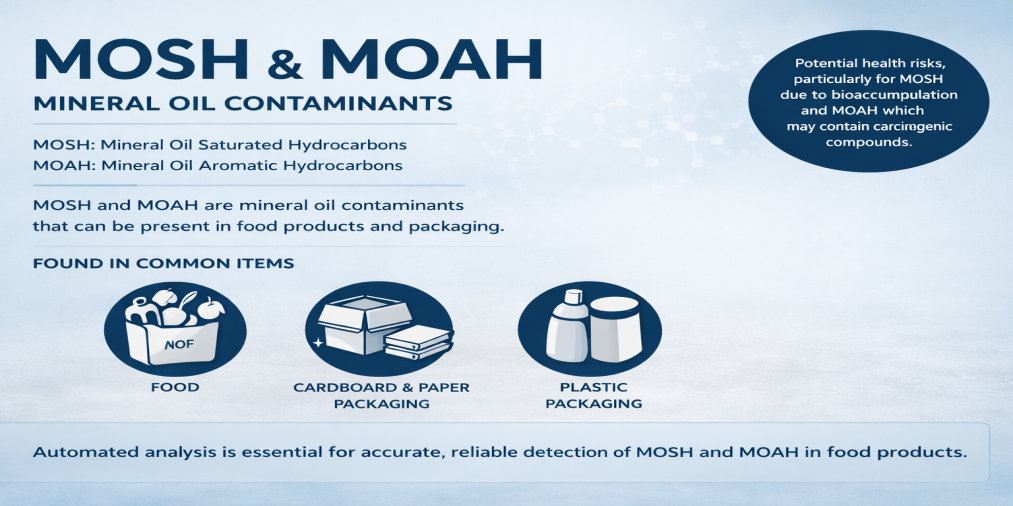
Mineral oil hydrocarbons (MOH) have become an important focus in food safety and quality control, particularly in packaged foods. These compounds are broadly classified into MOSH (Mineral Oil Saturated Hydrocarbons) and MOAH (Mineral Oil Aromatic Hydrocarbons), each presenting different analytical and regulatory considerations.
Accurate determination of MOSH and MOAH is essential due to their potential health implications and widespread sources, including packaging materials, processing aids, and environmental contamination.
Advanced analytical workflows combining automated sample preparation and GC-based techniques play a critical role in delivering reliable and reproducible results.
Understanding MOSH and MOAH
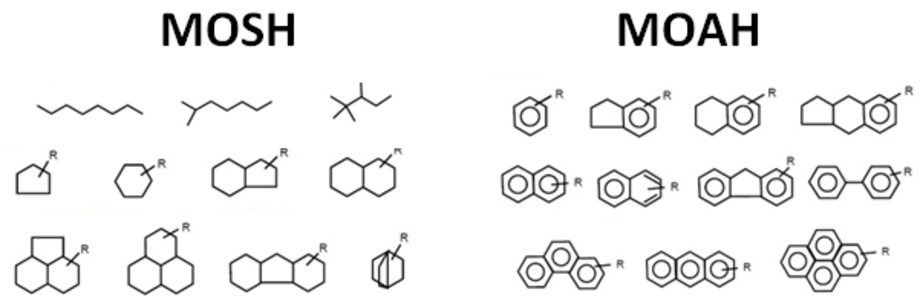
MOSH and MOAH are complex mixtures of hydrocarbons:
- MOSH: Linear and branched saturated hydrocarbons
- MOAH: Aromatic hydrocarbons, some of which may be of toxicological concern
They are typically found in:
- Edible oils and fats
- Dry foods such as cereals and grains
- Packaged foods due to migration from recycled materials
Why MOSH/MOAH Analysis is Challenging
MOSH/MOAH analysis is widely recognized as analytically complex due to:
1. Complex Mixture Composition
Both MOSH and MOAH consist of thousands of compounds, making separation and quantification difficult.
2. Matrix Interference
Food samples often contain:
- Natural hydrocarbons (e.g., olefins, waxes)
- Lipids and fats
These can overlap with MOSH/MOAH signals, requiring effective cleanup.
3. Need for Fraction Separation
Accurate analysis requires separation into:
- MOSH fraction
- MOAH fraction
This step is critical to avoid misinterpretation of results.
4. Sensitivity and Selectivity
Low-level detection of MOAH requires high sensitivity and careful method optimization.
Analytical Workflow for MOSH/MOAH Determination
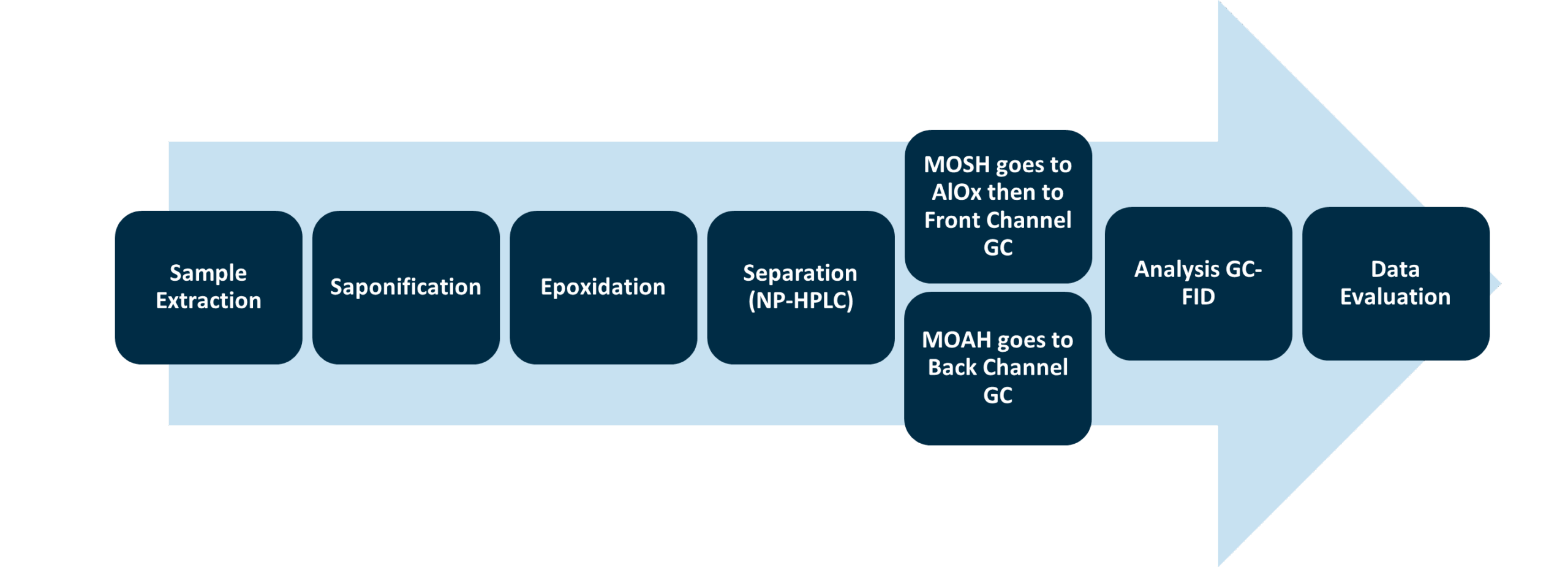
A typical MOSH/MOAH analysis workflow involves several critical steps:
Key Steps Explained
- Extraction
Isolates hydrocarbons from the food matrix - Cleanup
Removes interfering compounds such as fats and natural hydrocarbons - LC Fractionation
Separates MOSH and MOAH fractions - GC Analysis
Quantifies hydrocarbons using GC-FID or GC-MS
Detection Techniques for MOSH/MOAH
GC-FID (Flame Ionization Detection)
- Widely used for quantification of MOSH and MOAH
- Provides robust and reproducible results
- Suitable for routine analysis
GC-MS (Mass Spectrometry)
- Provides additional confirmation and identification
- Useful for complex or challenging samples
In many workflows, LC-GC-FID remains a standard approach, with automation enhancing consistency.
Applications in Food Analysis
MOSH/MOAH analysis is commonly applied in:
Edible Oils & Fats
- Monitoring contamination levels
- Supporting food safety compliance

Dry Foods
- Cereals, grains, and powdered products
- Pasta products
Packaged Foods
- Migration studies from packaging materials
- Quality control of finished products

Food Safety & Regulatory Testing
- Routine monitoring
- Risk assessment and compliance

Addressing MOSH/MOAH Analytical Challenges
To ensure reliable results, laboratories should focus on:
- Effective sample cleanup to remove interferences
- Accurate fractionation of MOSH and MOAH
- Validated methods and workflows
- Automation to reduce variability
Combining robust analytical techniques with automated sample preparation provides a practical solution for consistent and defensible results.

Conclusion
MOSH and MOAH analysis remains a technically demanding but essential component of modern food safety testing. The complexity of these compounds requires careful method design, reliable instrumentation, and consistent workflows.
By integrating automated sample preparation with GC-based analytical techniques, laboratories can improve efficiency, reproducibility, and data quality, supporting accurate assessment of mineral oil hydrocarbons in food products.